Every heavy-duty disc brake pad that leaves our plant is the result of 8 tightly controlled manufacturing steps. This is how raw powders become the truck and trailer disc brake pads trusted by fleets across Europe, America and the Middle East.
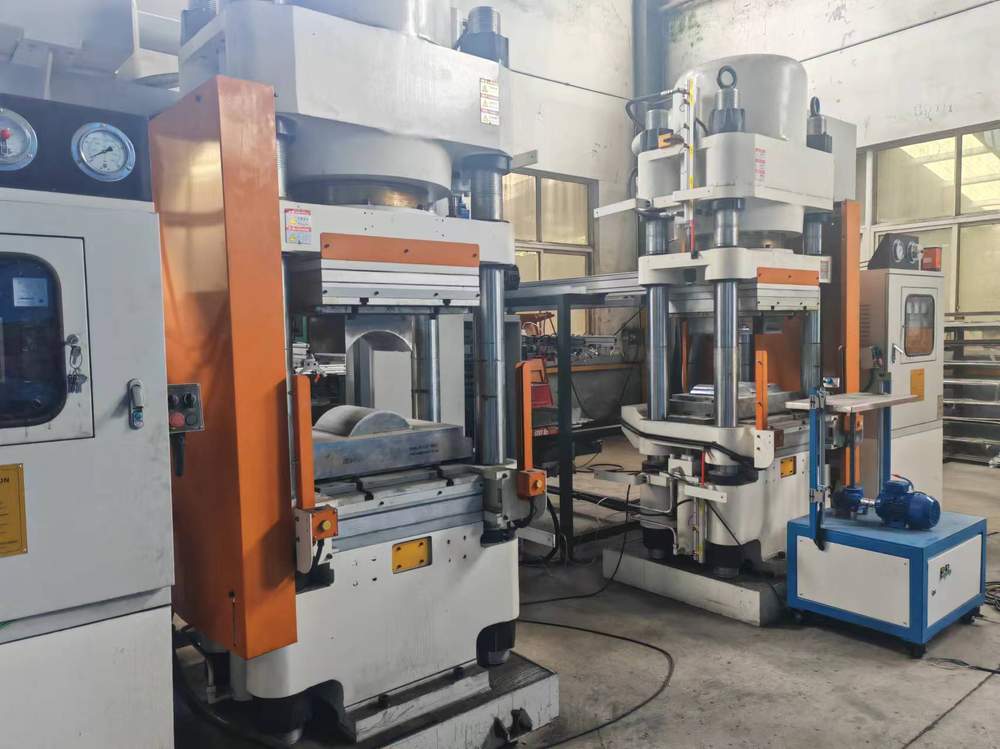
The 8-Step Manufacturing Process
1. Formulation & Weighing
Every pad starts with a precise friction formula — low-metallic, semi-metallic or ceramic. Raw materials such as resin binders, reinforcing fibers, friction modifiers and fillers are weighed to ±0.1% tolerance on automated scales. The formula determines the pad's friction coefficient, wear rate and noise behaviour for the specific WVA number.
2. Mixing
Weighed powders are blended in high-shear mixers until the batch is perfectly homogeneous. Mixing time, blade speed and temperature are logged for every batch, so even a 10,000-unit production run is fully traceable.
3. Preforming
The mixed compound is pre-pressed into a rough pad shape at room temperature. Preforming removes air and gives the material enough green strength to transfer cleanly into the hot press mould.
4. Hot Pressing
The preform is pressed onto a cleaned, shot-blasted steel backplate under high temperature (150–180 °C) and high pressure. The resin cures and bonds the friction material to the backplate in one shot — this is the step that decides pad integrity and shear strength.
5. Post-Curing / Heat Treatment
Pressed pads are heat-treated in ovens to fully cure the resin matrix and stabilize friction performance. This removes residual volatiles and guarantees stable braking from the very first application — no "green fade" on the road.

6. Precision Grinding
CNC grinding machines bring the friction surface to the exact thickness and flatness tolerances required by the OE drawing — typically ±0.1 mm. A flat, parallel surface guarantees full contact with the brake disc and even wear across the pad.
7. Chamfering, Slotting & Accessories
Edges are chamfered and slots are cut to control NVH (noise, vibration, harshness) and improve bedding-in. Under-layer, wear sensors and stainless-steel shims are bonded to the backplate where the application requires them — a critical detail for quiet, stable air-disc braking.
8. Inspection, Marking & Packaging
Every pad passes dimensional checks, hardness tests and visual inspection before being marked with the WVA number and batch code. Shear strength and friction performance are verified in our in-house laboratory, and the finished pads are boxed with full traceability from powder to pallet.
Quality Control & Certification
SAITE's disc brake pads are manufactured under ECE R90 certification, meaning every pad is tested for friction stability, shear strength and dimensional accuracy against the type-approved sample. Our in-house lab runs coefficient-of-friction tests, salt-spray corrosion checks and hardness measurements on every production batch — the same tests described in our quality lab article.
For a deeper look at how we tune the material itself, read Disc Brake Pad Material Formulation & Noise Control Technology. To see how the complete disc braking system is put together — including the rotor — continue to our brake disc (rotor) manufacturing process article.
And if you are comparing drum brakes, our related guides explain how brake shoes and complete brake shoe assemblies are built step by step.
What materials are disc brake pads made of?
Heavy-duty disc brake pads use friction formulations such as low-metallic, semi-metallic or ceramic compounds, blended with resins, fibers, fillers and friction modifiers, then hot-pressed onto a steel backplate.
Why do truck brake pads need chamfering and slotting?
Chamfered edges and slots break up the contact pressure distribution, reduce vibration and noise (NVH), and help the pad bed in faster on heavy-duty air disc brakes.
How is a WVA brake pad number assigned?
The WVA (Werknummer für Verkehrs-Ersatzteile) number is a standardized European reference for brake pads. Each WVA number identifies a specific pad shape, dimension and application — for example the WVA 29xxx series used on European trucks and trailers.
Looking for pads? Browse our full range of disc brake pad products, check popular references such as WVA 19032 and WVA 19036, or send us your OE numbers through the brake parts sourcing guide.